


Topic: AIF - 1B - 1 LHR
1st LHR, AIF
1st Australian Light Horse Regiment
Outline
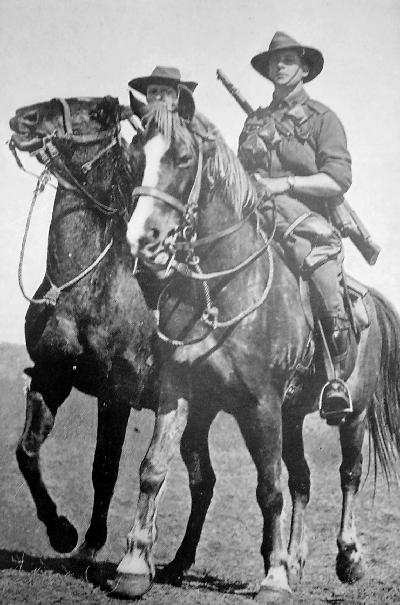
[From: Sydney Mail, 7 October 1914, p. 21.]
Outline of the 1st Australian Light Horse Regiment, AIF
Formation
Formed in August 1914 as part of the 1st Contingent and attached to the Australian Division, the 1st Light Horse Regiment was made up of Light Horsemen from five different Militia Regiments. This was the only New South Wales Regiment recruited from a majority of men drawn immediately from the Militia formations. The Regiment included:
"A" Squadron recruited mainly from:
5th Light Horse Regiment (31 men); and,
6th Light Horse Regiment (59 men).
"B" Squadron recruited mainly from:
7th Light Horse Regiment (41 men); and,
11th Light Horse Regiment (62 men).
"C" Squadron recruited mainly from:
9th Light Horse Regiment (49 men).
Training

[Click on page for larger version.]
Training of the 1st Light Horse Regiment occurred at Rosebury Park in Sydney from August until October 1914.
Embarkation
Embarkation of the 1st Light Horse Regiment occurred by the HMAT A16 Star of Victoria from Sydney on 19 October 1914.
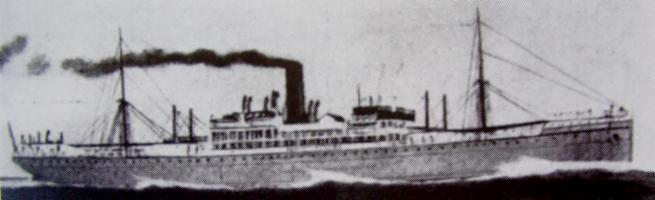
The 1st Light Horse Regiment sailed by convoy from Albany and passed by the action against the Emden at the Cocos Islands. The Star of Victoria disembarked the 1st Light Horse Regiment in Egypt on 8 December 1914.
Colour Patch
Initially, the only colour separation of the various Australian mounted troops was by use of the pennant. The marker pennants were carried on poles to mark lines troop lines in camps in Egypt. They were not lance pennants as the Australian lancers had red over white pennants on their lances.

Pennant of the 1st Light Horse Regiment
While this pennant was useful in distinguishing horse and troop lines, it failed to identify the individual with a unit. The AIF 1st Australian Division Standing Orders issued in December 1914 ordered the Australian Light Horse Regiments to wear a 4 inch wide [10.2cm] blue armband with the regiment name marked on the band in black lettering.
The earlier systems proved to be ineffective so to assist with identification of the men in the various units within the AIF, Divisional Order No 81 (A) Administration was issued at Mena on 8 March 1915 detailing the Colour Patch for the 1st Light Horse Regiment as others received their colours. The colour patch was made of cloth 1¼ inches wide and 2¾ inches long and worn on the sleeve one inch below the shoulder seam. The colour patch for the 1st Light Horse Regiment was light blue over white.

The 1st Light Horse Regiment carried the white Brigade colour as the lower triangle part of the colour patch, while the light blue unit colour was on the top. This is illustrated with the above presentation.
Gallipoli
As mounted troops, the Light Horse was considered to be unsuitable for work in Gallipoli. The mounted troops volunteered to operate as infantry and thus were sent to Gallipoli with the 1st Light Horse Regiment landing on 12 May 1915. Only once was this regiment used for offensive activities which occurred on the morning of 7 August 1915 with an attack on a Turkish position known as "the Chessboard". The tragic result was some 147 casualties from the 200 men who were involved in the charge. For the balance of the time the 1st Light Horse Regiment remained at Gallipoli, the unit played a defensive role.
Western Frontier Force
After the return to Egypt, the 1st Light Horse Regiment reformed and re-equipped. The reorganisation of the Light Horse led to the formation of the ANZAC Mounted Division to which the 1st Light Horse Regiment became a foundation member.
For the first five months of 1916, between January and May, the 1st Light Horse Regiment was deployed throughout the Nile valley to defend the Egyptian economic centres from the interruption by the Senussi infiltrating from Siwa Oasis.
Defence of Egypt
On 14 May1916, the 1st Light Horse Regiment moved to join its parent brigade, the 1st Light Horse Brigade, which was taking part in the defence of the Suez Canal. The work was hot and monotonous. they remained here until moved to the Romani region to bolster the defence of that area.
Sinai
The 1st Light Horse Brigade played an important role in beating back the Turkish invasion of the Suez Canal zone at Romani. Now known as the Battle of Romani which lasted from 4-6 August which was quickly followed by the Battle of Katia and then Bir el Abd on 9 August. All the actions in which the 1st Light Horse Regiment finally led to the defeat of the Ottoman Canal Expeditionary force and its retreat to Bir el Mazar.
Over the next few months, the 1st Light Horse Regiment took part in the Allied advance over the Sinai leading to the fall of Bir el Mazar, then El Arish followed by Bir el Magdhaba and finally Rafa in January 1917. The Ottoman forces were expelled from the Sinai and were poised to be tackled in Palestine.
Palestine
The 1st Light Horse Regiment was assigned to protect the rail line and lines of communications for the first months of 1917. They missed the First Battle of Gaza but were back at the fron by 6 April 1917 and took part in the Second Battle of Gaza on 19 April 1917.
The 1st Light Horse Regiment took part in the Battle of Beersheba and then the follow up actions that lasted until early January 1918. This included such actions as the advance to Jaffa.
After the fall of Jerusalem the 1st Light Horse Regiment moved to the Jordan Valley and took parts in operations in this region. This included the taking of Jericho, the attack on Amman during 27 March - 2 April 1918 and Es Salt Raid of 30 April – 4 May 1918. It's last major action prior to the breakout was to repel the German Asien Corps attack on Abu Telllul, 14 July 1918.
Amman
At the opening of the final Allied offensive on 19 September 1918, the 1st Light Horse Regiment took part in the invasion of the Moab hills for the third time. This time Amman was captured and finally, the Ottomans called for an Armistice on 30 October 1918.
Return to Australia
After the conclusion of hostilities, the 1st Light Horse Regiment was marked to return to Australia. Prior to that action, one of the saddest actions occurred for the Australian Lighthorsemen, they had to farewell their best friends, the horses. All the Light Horse unit horses's health was ascertained with the fit horses being transferred to the Indian Cavalry while those in poor condition were destroyed by the Veterinary units. On 12 March 1919 the 1st Light Horse Regiment embarked from Egypt for the long voyage to Australia where the unit was disbanded.
Commanding Officers
Lieutenant Colonel John Baldwin Meredith
Lieutenant Colonel Hugh Venables Vernon
Lieutenant Colonel Thomas William (Bill) Glasgow
Lieutenant Colonel Cecil Horace Granville
Lieutenant Colonel George Macleay Macarthur-Onslow
Decorations earned by the 1st Light Horse Regiment
- 5 DSO - Distinguished Service Orders
- 10 MC - Military Crosses
- 2 DCM - Distinguished Conduct Medals
- 18 MM - Military Medals
- 42 MID - Mentioned in Despatches
- 8 foreign awards
Campaigns
Gallipoli
- Anzac
- Defence at Anzac
- Suvla
- Sari Bair
- Gallipoli 1915-1916
Egypt
- Senussi Campaign
- Defence of Egypt
Sinai
- Romani
- Magdhaba
- Rafa
Palestine
- Second Battle of Gaza
- Third Battle of Gaza
- Beersheba
- El Mughar
- Nebi Samwill
- Jerusalem
- Jaffa
- Jericho
- Amman
- Es Salt
- Abu Tellul
- Megiddo
- Nablus
- Palestine 1917-1918
Casualties suffered by the 1st Light Horse Regiment
- 222 killed
- 679 wounded
War Diary
The Australian War Memorial has put these on line and may be accessed here:
Embarkations:
The following list details all the embarkations in support of the 1st Light Horse Regiment, AIF, during the Great War. Each entry details the individual soldier's: rank on embarkation; full name; Declared age; last occupation held; last address as a civilian; enlistment Date; and, ultimate fate. Each man is linked to a brief military biography where ever possible. One interesting point is that many of the men listed in the embarkation roll for the 1st Light Horse Regiment ended up in a different unit altogether. This list details the men's starting point in the AIF.
| Regimental Headquarters Section | Sydney, New South Wales on board HMAT A16 Star Of Victoria 20 October 1914 |
| "A" Squadron | Sydney, New South Wales on board HMAT A16 Star of Victoria 20 October 1914 |
| "B" Squadron | Sydney, New South Wales on board HMAT A16 Star Of Victoria 20 October 1914 |
| "C" Squadron | Sydney, New South Wales on board HMAT A16 Star Of Victoria 20 October 1914 |
| Machine Gun Section | Sydney, New South Wales on board HMAT A16 Star Of Victoria 20 October 1914 |
| 1st Reinforcement | Sydney, New South Wales on board HMAT A42 Boorara 20 December 1914 |
| 2nd Reinforcement | Sydney, New South Wales on board HMAT A25 Anglo Egyptian 8 February 1915 |
| 3rd Reinforcement | Sydney, New South Wales on board HMAT A6 Clan Mccorquodale 6 February 1915 |
| 4th Reinforcement | Sydney, New South Wales on board HMAT A9 Shropshire 17 March 1915 |
| 5th Reinforcement | Newcastle, New South Wales on board HMAT A41 Bakara 22 May 1915 |
| 6th Reinforcement | Sydney, New South Wales on board HMAT A65 Clan MacEwen 28 June 1915 |
| 7th Reinforcement | Sydney, New South Wales on board HMAT A21 Marere 16 August 1915 |
| 8th Reinforcement | Sydney, New South Wales on board HMAT A54 Runic 9 August 1915 |
| 9th Reinforcement | Sydney, New South Wales on board HMAT A8 Argyllshire 30 September 1915 |
| 10th Reinforcement | Sydney, New South Wales on board HMAT A4 Pera 12 October 1915 |
| Sydney, New South Wales on board HMAT A47 Mashobra 4 October 1915 Sydney, New South Wales on board SS Hawkes Bay 23 October 1915 | |
| 12th Reinforcement - Hawkes Bay Group | Sydney, New South Wales on board SS Hawkes Bay 23 October 1915 Sydney, New South Wales on board HMAT A72 Beltana 9 November 1915 |
| 13th Reinforcement | Sydney, New South Wales on board HMAT A60 Aeneas 20 December 1915 |
| 14th Reinforcement | Sydney, New South Wales on board RMS Osterley 15 January 1916 |
| 15th Reinforcement | Sydney, New South Wales on board HMAT A26 Armadale 21 March 1916 |
| 16th Reinforcement | Sydney, New South Wales on board HMAT A25 Anglo Egyptian 12 May 1916 |
| 17th Reinforcement | Sydney, New South Wales on board HMAT A39 Port Macquarie 26 April 1916 |
| 18th Reinforcement | Sydney, New South Wales on board HMAT A20 Hororata 2 May 1916 |
| 19th Reinforcements | Sydney, New South Wales on board RMS Mongolia 8 July 1916 |
| 20th Reinforcement | Sydney, New South Wales on board RMS Malwa 22 July 1916 |
| 21st Reinforcement | Sydney, New South Wales on board RMS Mooltan 19 August 1916 |
| 22nd Reinforcement | Sydney, New South Wales on board HMAT A13 Katuna 23 November 1916 |
| 23rd Reinforcement | Sydney, New South Wales on board RMS Karmala 3 February 1917 |
| 24th Reinforcement | Melbourne, Victoria on board HMAT A42 Boorara 10 May 1917 |
| 25th Reinforcement | Melbourne, Victoria on board HMAT A42 Boorara 10 May 1917 |
| 26th Reinforcement | Sydney, New South Wales on board RMS Morea 17 February 1917 |
| 27th Reinforcement | Sydney, New South Wales on board HMAT A15 Port Sydney 9 May 1917 |
| 28th Reinforcement | Sydney, New South Wales on board HMAT A17 Port Lincoln 11 June 1917 |
| 29th Reinforcement | Sydney, New South Wales on board HMAT A55 Kyarra 3 September 1917 |
| 30th Reinforcement | Melbourne, Victoria on board HMAT A73 Commonwealth 2 November 1917 |
| 31st Reinforcement | Melbourne, Victoria on board HMAT A73 Commonwealth 2 November 1917 |
| 32nd Reinforcement | Melbourne, Victoria on board HMAT A73 Commonwealth 2 November 1917 |
| 33rd Reinforcement | Sydney, New South Wales on board SS Canberra 16 November 1917 |
| 34th Reinforcement | Sydney, New South Wales on board HMAT A38 Ulysses 19 December 1917 |
| 35th Reinforcement | Sydney, New South Wales on board RMS Ormonde 2 March 1918 |
See: Troop transport ships for information and photographs about the various ships employed in transporting the troops to Egypt.
Books about the 1st Light Horse Regiment:
Vernon, PV, The Royal New South Wales Lancers, 1885-1985, Sydney 1985.
Treasure, C, Perc Treasure Light Horseman, Sydney 1988.
Williamson, BC, Six Bob Trooper - The Life of Alfred Thomas Winterton of the 1st Light Horse Regiment, Sydney 1992.
Further Reading:
1st Australian Light Horse Regiment, AIF
1st Australian Light Horse Regiment, Roll of Honour
Battles where Australians fought, 1899-1920
Citation: 1st Australian Light Horse Regiment, AIF, Outline

